September 21, 2026
Are we training AI, or is it training us?
The debate usually starts from the wrong premise: will robots take our jobs? This question is comforting because its answer sits at a deferrable date in the future. Yet, the real shift has already happened, and it has nothing to do with robots.
The visible race is lagging behind. The invisible race is already over.
The noisy side: robots
In January 2026, Tesla announced the mass production of Optimus; by March, over a thousand units were reported to be in factories. Headlines read this as the dawn of the humanoid robot age.
Yet that same month, Elon Musk told investors that these units are primarily used for learning and data collection, not performing meaningful manufacturing work in factories. The 2025 target was 5,000 units; the actual realization was a few hundred.
So the most talked-about AI story is behind schedule and openly admitting it. The robot isn't doing your job yet. It's learning from you.
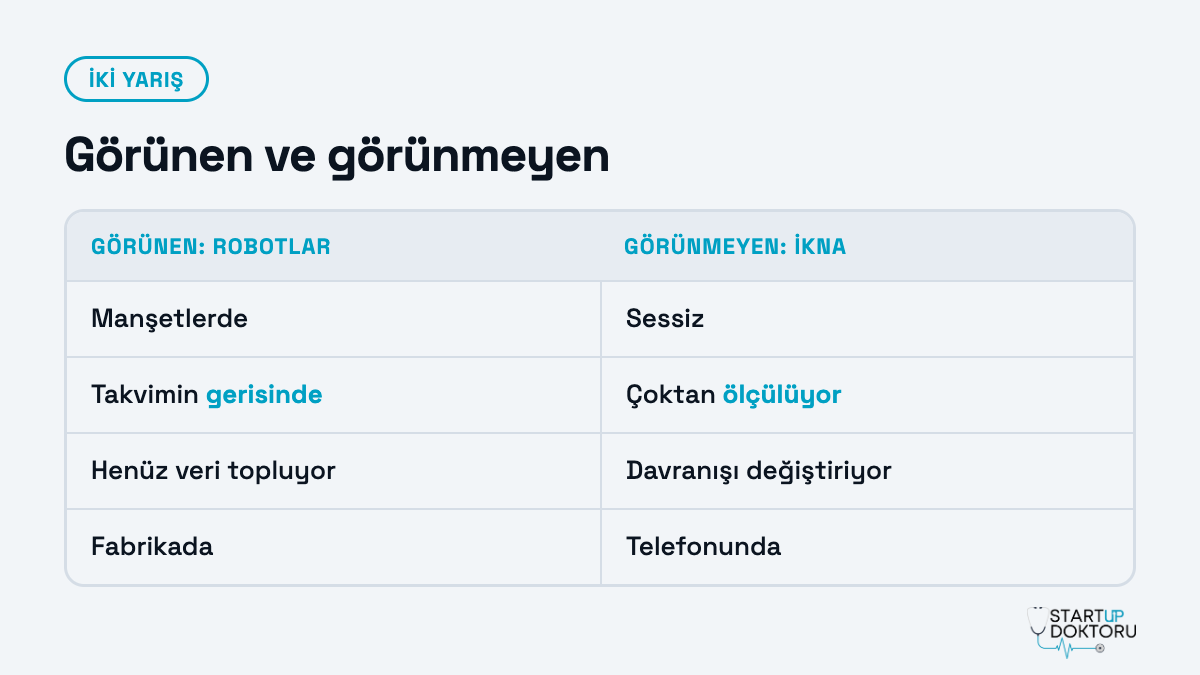
The quiet side: persuasion optimization
Now look at the other side. 83% of advertising executives have integrated AI into their creative process, up from 60% two years ago. Google reports that in a single quarter, advertisers generated nearly 70 million ad assets using generative models.
It's not the scale of the numbers that matters, but their direction. In a field study, entirely AI-generated visuals achieved up to 50% higher click-through rates compared to human-made ones.
Read that sentence again. A system has learned to guide human attention better than humans can. And it learned this from your clicks.
The robot isn't doing your job yet. But an algorithm is doing a better job of persuading you than you are.
Who is training whom?
"We are training AI" is technically true, but incomplete. Training is not a one-way street. When you accept a recommendation, the system learns; when the system chooses what to show you, you learn something too — what is normal, what is desirable, what is possible.
Content recommendation algorithms determine which ideas come to the fore, search engines determine which sources are visible, and assistants determine which options are presented. The cumulative impact of this filtering on societal decision-making has not yet been sufficiently researched.
The problem isn't malice. The problem is this: the line between your own preference and the preference suggested to you is blurring. And you don't realize it's blurring, because the suggestion was precisely designed to appeal to you.
The most expensive part of intelligence isn't information, it's attention. If someone else is choosing where to direct your attention, they are largely choosing what you think.
The next five years
I won't make a definitive prediction; no one can. But three trends are currently measurable, and all three are heading in the same direction.
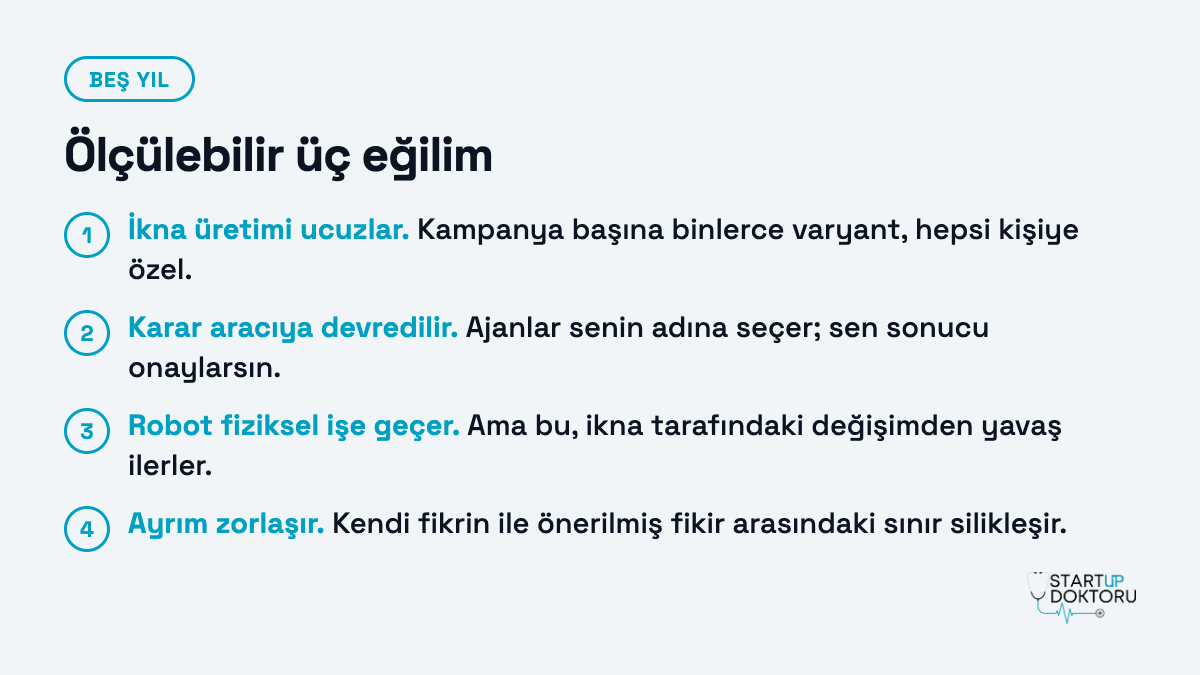
Pay attention: the first three are questions of technology, the fourth is not. The fourth is a question of habit, and the answer lies with you.
What does this mean for founders?
The most common mistake founders make is dismissing this debate as philosophical conversation. Yet it directly concerns your business model.
If your product provides a recommendation, you are no longer just selling a feature — you are shaping the user's decision. This makes your product more valuable and increases your responsibility. The two come together.
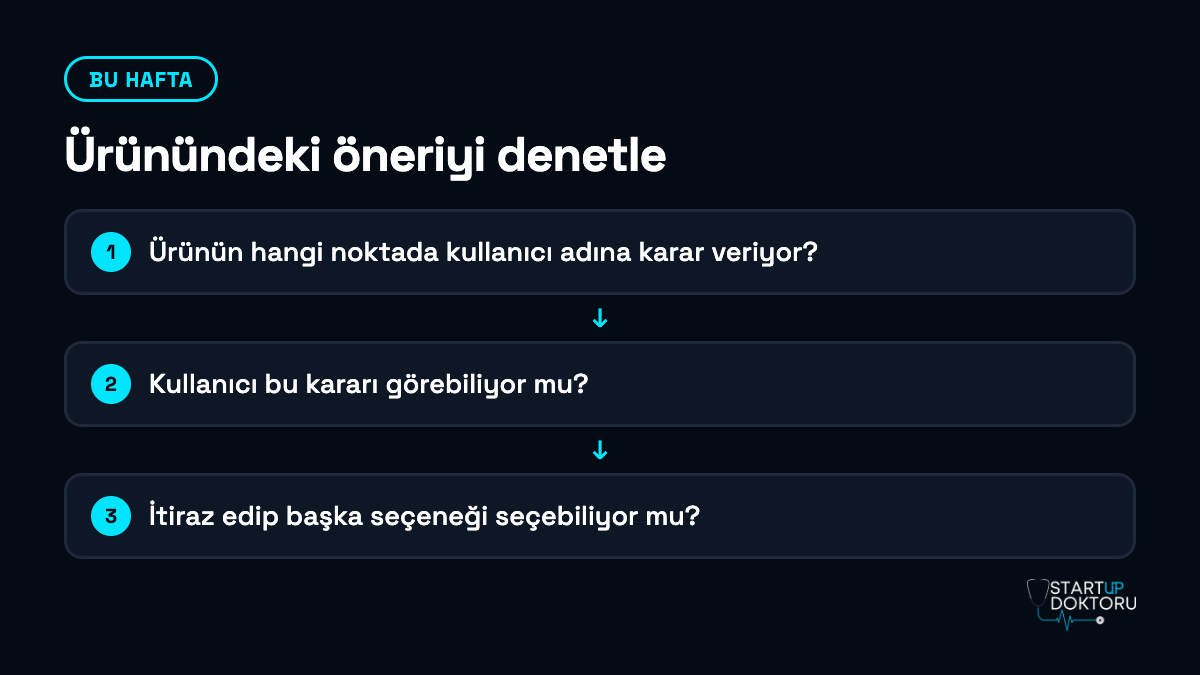
If you answer "no" to the third question, your product isn't a tool, it's a steering mechanism. This isn't an accusation, it's a design decision — but it needs to be made consciously.
So what is the answer?
Framing the question as "are we using it, or is it using us" is a binary trap. The real answer is both: while the system learns from you, you learn from the system. The difference appears when you measure which side is learning.
Companies are measuring. Clicks, dwell time, conversions — everything is logged. If you aren't measuring your own side, that is where the asymmetry begins.
Here is a simple thing you can do this week: write down the last three important decisions you made. Next to each one, add where you first heard about that decision. If all three came from a feed, you've found your answer.
Frequently asked questions
Is AI really steering human decisions, or is it just reflecting our preferences?
Both are happening simultaneously, making them hard to separate. The system learns from your past preferences, and then uses what it learned to choose what to show you. What it shows shapes your next preference. Because the loop closes, the line between "my preference" and "what was recommended to me" is erased.
Will robots take over jobs in the next five years?
Today's data doesn't support this. According to Tesla's own statements, humanoid robots in factories are primarily in the learning and data collection phase, achieving a tenth of their 2025 production target. The physical labor side is progressing noticeably slower than the persuasion and decision side.
How can a founder protect themselves from this shift?
Protection is the wrong word; designing your product consciously is the right one. If your product makes a decision on behalf of the user, clarify three things: at what point is the decision made, can the user see it, and can they object and choose another option? If you answer "no" to the third, your product is not a tool, but a steering mechanism.
Should I trust AI recommendations?
It's not a matter of trusting or not trusting, it's a matter of measuring. Companies measure your clicks, dwell time, and conversions. If you aren't measuring your own side, that's where the asymmetry begins. A simple starting point: write down where you first heard the idea next to your last three important decisions.
Sources
- Humanoid Robots in 2026: What Is Actually Deployed — Technology.org — Actual deployment status of Optimus and Figure
- Tesla Optimus Deployment Tracker (2026) — The gap between production targets and actual output
- AI-Powered Advertising Campaign Statistics — Luma — 83% adoption rate and click comparison
- How does AI erode human will? — Teyit — The impact of recommendation systems on decision-making processes
- Can Algorithms Be Neutral? — TÜBİTAK Bilim Genç — Algorithmic decision-making processes
Make your own decisions
Knowing which decisions you delegate to whom while building your startup is just as important as your product. I'm breaking down what you need to know before facing investors. Check out the free training.
Ready to take your startup up a level?
See the Ebook ($6)