September 30, 2026
Will states defend communism against techno-feudalists?
On September 23, 2026, two figures spoke at the UN Security Council: Sam Altman from OpenAI and Dario Amodei from Anthropic. Three weeks prior, Altman was on stage at the G20 Innovation Ministerial Meeting. Back in June, both were seated at the leaders' table during the G7 summit.
It is worth reading these sentences once more. These are not elected individuals. They represent no country. They answer to no voters. Yet they sit at the table of sovereign states.
It is time to name what is happening, and some already have: techno-feudalism.
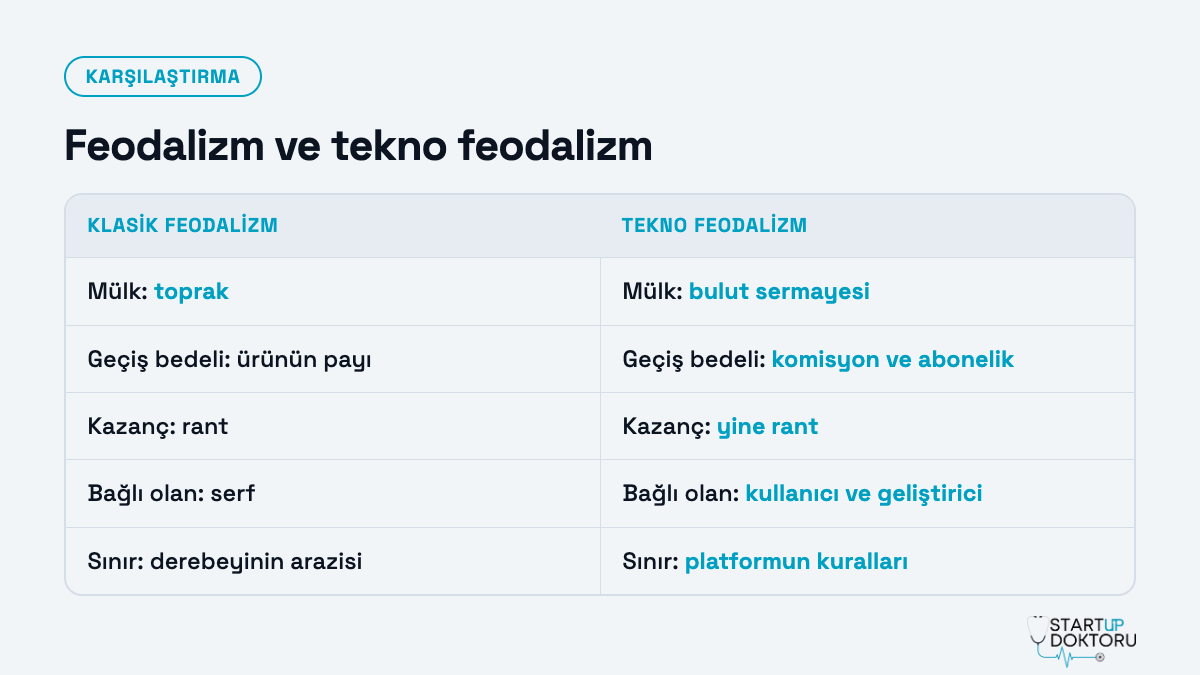
First, what was feudalism?
Under feudalism, wealth came not from production, but from ownership. The lord owned the land. The peasant tilled that land and gave a portion of the yield to the lord. The lord did not produce anything better, did not sell cheaper, and did not compete. He simply owned the tollbooth you had to pass through.
Earnings were called not profit, but rent. Profit springs from competition; rent springs from inevitability.
Capitalism tore this down. Markets arrived, competition arrived, profit arrived. Whoever made a better product won. At least, that was the theory.
So, what is techno-feudalism?
Greek economist Yanis Varoufakis coined the term in 2023. His thesis: capitalism did not die; it was superseded. What replaced it looks a lot older.
As Varoufakis describes it, the new lords own not land, but cloud capital. App stores, search engines, social networks, cloud infrastructure, model APIs—they are all mandatory tollbooths. Companies selling through them pay a passage fee, even if they built the product themselves.
Techno-feudalism replaces profit with rent, and market competition with monopoly power.
Varoufakis speaks of two new classes. The cloud proletariat: workers who draw a salary but whose tasks are managed by an algorithm. The cloud serf: that is, all of us. While using platforms, we generate content, behavior, and data for free, feeding that capital accumulation.
The word serf might sound harsh. But ask yourself: what did you get in return for the data you produced today?
What do the numbers say?
The concept is debatable, but the concentration is not. In the first half of 2026, OpenAI and Anthropic together raised $217 billion. That translates to 43% of all global startup funding during those six months.
Two companies. Nearly half of all capital.
In March 2026, OpenAI raised approximately $122 billion, marking the largest private financing round on record. By May, Anthropic reached a valuation of $965 billion, surpassing OpenAI. xAI merged into SpaceX via an all-stock transaction valued at $250 billion.
These companies are no longer operating at startup scale. We are talking about figures larger than the GDP of certain nations.
At the other extreme: a wave of layoffs
While capital consolidates in a handful of companies, employment is moving in the opposite direction. And this is no longer a forecast—it is stated directly in corporate earnings.
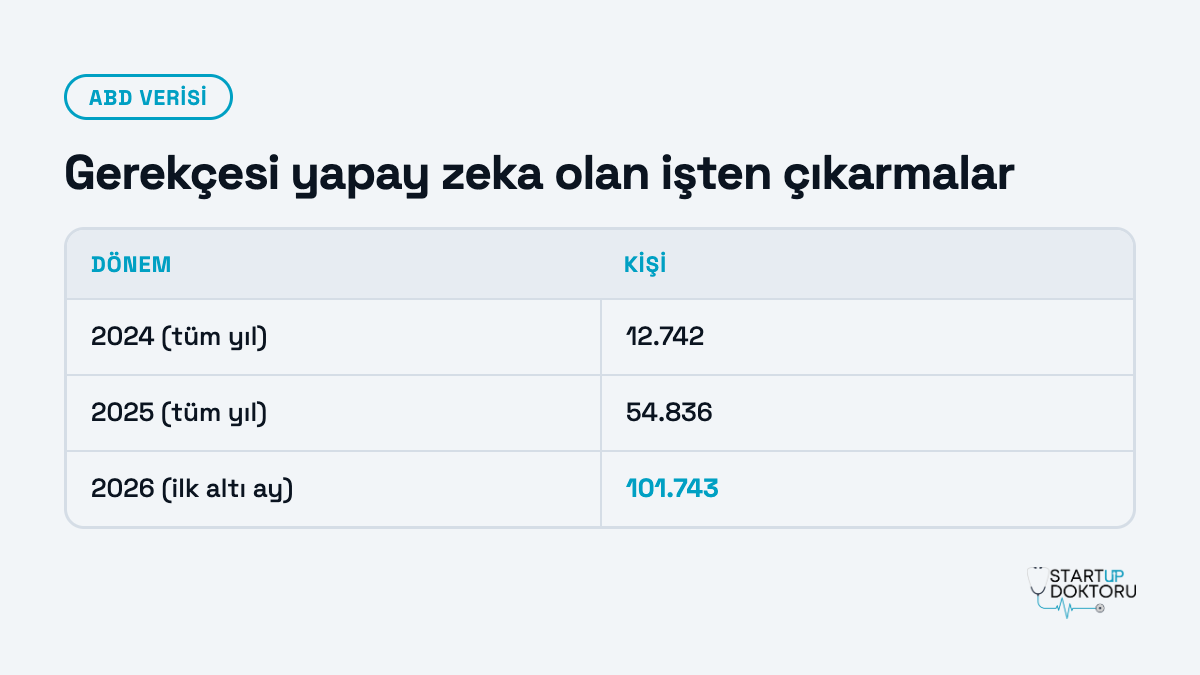
It has multiplied eightfold in two years. Moreover, the first half of 2026 alone is nearly double the entirety of 2025.
May 2026 was a record month: 38,579 people in a single month. That represents 40% of all layoffs announced during that period. Over the course of the full year, the tech sector saw more than 225,000 people lose their jobs across 519 separate incidents.
Looking at individual companies makes the picture even more concrete. In March 2026, Block cut roughly 40% of its global workforce—4,000 people—citing the capabilities of AI tools. Oracle's cutbacks reached approximately 21,000 employees.
There is a crucial detail here: most of these companies are not operating at a loss. They are profitable and still cutting. Because the money saved is being funneled right back into AI infrastructure.
The state's response: basic income
Here, the inevitable question arises: what happens to the masses left unemployed?
The solution brought to the table by states is basic income. UK Investment Minister Lord Jason Stockwood stated that they are considering universal basic income options for workers in sectors threatened by AI. His phrasing is striking: to provide a soft landing for disappearing industries.
The funding source he proposed is even more noteworthy: taxing tech companies.
Another model under discussion is a system that covers the vital necessities of regional residents while excluding luxuries. In literature, this is known as universal basic services. The idea is to directly provide items like housing, transit, healthcare, and communication instead of cash. According to data from the Stanford Basic Income Lab, 163 basic income pilots have been run in the US alone to date, with 41 still active.
The collective finding of these pilots is clear: people who receive regular payments spend the money on basic needs and do not stop working.
So, is this communism?
The short answer: no. And that is where the truly interesting part begins.
Communism is the common ownership of the means of production. There is no such thing in basic income. Whose factory is it, whose model is it, whose data center is it—they all remain untouched. The only change is that a portion of the earnings is collected via taxation and redistributed. This is not surrendering ownership, but making ownership sustainable.
Notice this: among the most vocal advocates of basic income are Elon Musk and Sam Altman. Musk supports the idea of a universal high income funded by regular government payouts, and Altman champions a similar concept.
Why? Because a platform without customers generates no rent. If the serf has no money for bread, they cannot pay for subscriptions. Basic income is not the enemy of the system; it is its insurance policy.
The lord does not want the peasant to starve. He only wants the peasant not to leave the land.
Therefore, the question is not "will states advocate communism?" The real question is: do states still retain the power to funnel a portion of that rent back to society? Donald Trump labeling international AI oversight a globalist scheme shows just how contested that power is.
There is a counter-argument
To be fair, the concept of techno-feudalism is not universally accepted. There is fierce pushback in Jacobin and within academic literature: what we are experiencing is not feudalism, but simply hyper-concentrated capitalism.
The logic behind this objection is robust. These companies still compete, are still priced by the market, and can still go bankrupt. A feudal lord did not go bankrupt. Furthermore, a serf lacked the right to abandon the land; you have the right to delete an app.
I believe it is best to use this concept not as a diagnosis, but as a lens. I do not know if it is feudalism. But I am certain that "owning the gate you must pass through" is today's most profitable business model.
What does this picture mean for a founder?
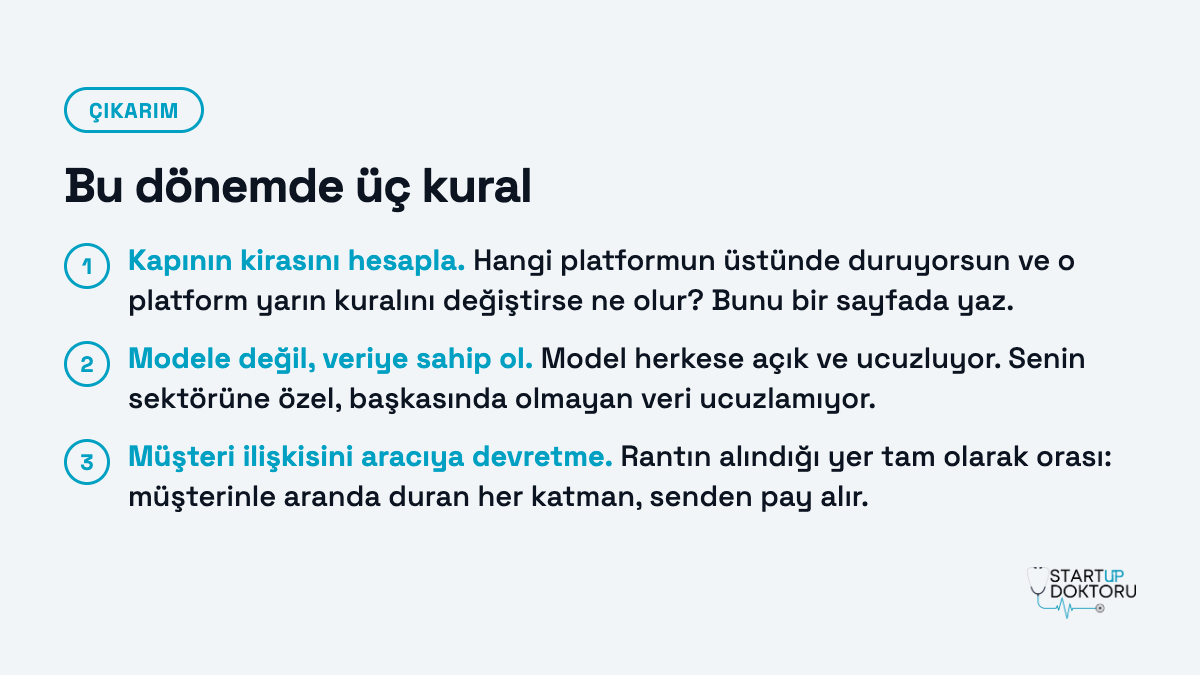
From a distance, it looks overwhelming. Up close, it yields three very concrete takeaways.
The layoff wave also has a flip side for founders. There is an abundance of experienced, mid-career professionals left jobless in the market. Someone whom a massive corporation considers excess baggage today could become the first member of your founding team.
The greatest opportunity of any era usually sits right beside its greatest pain.
The next five years
I will not make predictions, but there are three thresholds to watch.
First is taxation. If a funding model targeting tech companies—such as the one Stockwood proposes—is genuinely established, it means state power remains intact. If it cannot be built, the answer is equally clear.
Second is concentration. Will the 43% share continue to climb, or will open-source models pull that percentage down? This metric is the numerical equivalent of the techno-feudalism debate.
Third is employment. Will these layoffs be balanced by new jobs generated by artificial intelligence? It balanced out during the Industrial Revolution, but an entire generation was crushed in the interim. The real question is: how long will the transition gap be this time?
And for you, the ultimate question is: will you be one of the gatekeepers in this shift, or one of those passing through the gate?
Frequently Asked Questions
What is techno-feudalism?
A concept coined by economist Yanis Varoufakis in 2023. His thesis is that capitalism has been replaced by an order built on cloud capital. In this setup, earnings stem not from profits born of competition, but from rents derived from owning mandatory digital infrastructure. Varoufakis calls the holders of this infrastructure cloud owners, and the users who feed the platforms for free, cloud serfs.
How many people lost their jobs because of artificial intelligence?
In the US, layoffs directly attributed to AI by companies stood at 12,742 in 2024 and 54,836 in 2025, surging to 101,743 in just the first half of 2026. Across the entire tech sector, more than 225,000 people lost their jobs over 519 separate incidents throughout 2026. May 2026 set a record with 38,579 people in a single month, accounting for 40% of all layoffs that month.
Are AI investments really concentrated in just a few companies?
Yes. In the first half of 2026, OpenAI and Anthropic together raised $217 billion, representing 43% of all startup funding globally during that window. Over the same period, global venture capital surpassed $510 billion in a six-month span for the first time, but four mega-rounds dominated the headlines.
Is universal basic income communism?
No. Communism envisions the common ownership of the means of production; under basic income, property does not change hands—only a fraction of earnings is gathered through taxes and redistributed. In fact, tech founders like Elon Musk and Sam Altman are among the loudest proponents of this idea, because platform revenues cannot survive in a society stripped of purchasing power.
What is the difference between universal basic income and universal basic services?
Basic income provides cash, allowing individuals to choose how to spend it. Basic services directly provide items like housing, transit, healthcare, and education instead of cash, covering vital needs while excluding luxuries. The two rely on different philosophies: one prioritizes freedom of choice, while the other prioritizes guaranteed needs.
Are AI founders genuinely represented at the state level?
They are not elected representatives, but they occupy seats at high-level tables. In 2026, Sam Altman and Dario Amodei attended an executive roundtable at the June G7 summit, Altman spoke at the G20 Innovation Ministerial Meeting on September 2, and both delivered presentations on AI risks at the UN Security Council on September 23.
What does this landscape mean for a newly launched startup?
It carries three practical implications. First, you must know which platform you are building on and what happens if that platform changes its rules. Second, while foundational models get cheaper, industry-specific data does not—that is where value accumulates. Third, every layer standing between you and your customer takes a cut, making ownership of the customer relationship critical.
Sources
- Altman, Amodei push for AI cooperation at UN — CNBC — Sept 23, 2026 UN Security Council presentation
- G20 tech takeaways: Innovation Ministerial — CNBC — Altman's Sept 2, 2026 G20 address; participation of Huang and Brown
- Anthropic and Google DeepMind CEOs at G7 — CNBC — Executive roundtable at the June 2026 G7 summit
- Trump calls AI oversight a 'globalist scheme' — Fortune — State-platform tension
- OpenAI and Anthropic Take 43% of H1 2026 Venture Funding — AI Weekly — $217 billion and 43% concentration rate
- Anthropic tops OpenAI as most valuable AI startup — CNBC — $965 billion valuation
- Tech Layoffs Top 225,000 in 2026 — Startup Fortune — 225,122 people, 519 incidents; Block and Oracle cuts
- AI Layoffs Tracker — Founder Reports — 2024-2026 layoffs attributed to AI and the May 2026 record
- Elon Musk, optional work and UBI — Fortune — Lord Jason Stockwood's statements on basic income and tech taxes
- Radical Proposal: Universal Basic Income — Stanford HAI — Stanford Basic Income Lab: 163 pilots, 41 active
- Universal basic services — Wikipedia — Model providing services instead of cash
- Technofeudalism: What Killed Capitalism — Varoufakis (Jacobin critique) — Definition of the concept and primary objections
- Capitalism is capitalism, not technofeudalism — Nicholas Gane — Academic counter-argument
Will you be among the gatekeepers?
Securing investment in this era is not just about raising capital; it is about positioning yourself on the right side. I break down everything you need to know before stepping in front of investors in a free training. Check out the free training.
Ready to take your startup up a level?
See the Ebook ($6)